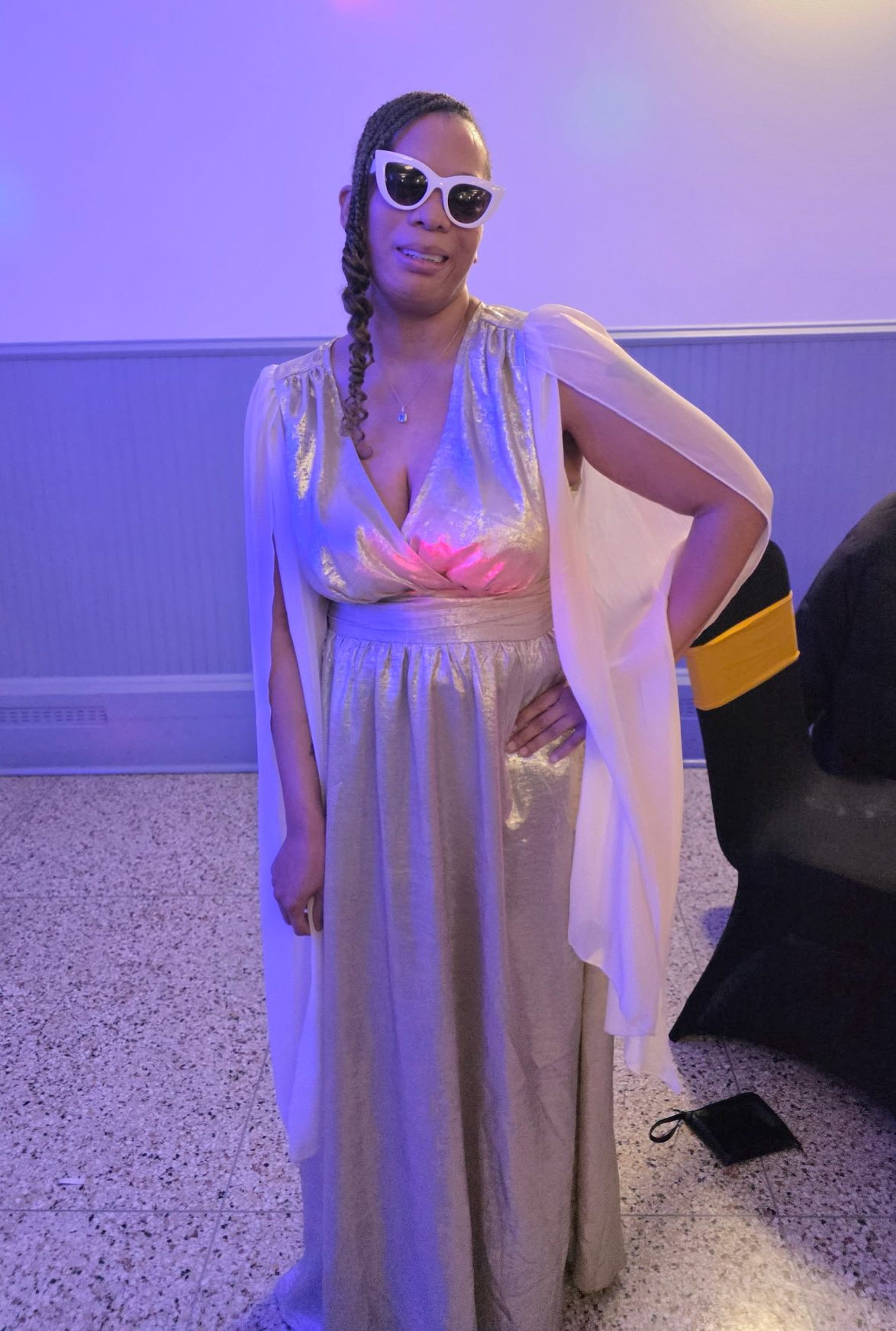
If you only saw the book covers, the author photos, the polished captions online, you might assume my life unfolded in a straight line. You might think I always knew I’d be here—publishing novels, speaking about resilience, turning pain into prose.
But my life didn’t begin with applause.
It began in a snowstorm.
I entered this world six weeks early while winter raged outside. My mom says that should have been her first clue that I was going to do everything in dramatic fashion. I’ve never been one for gentle entrances.
By nine months old, my grandmother noticed something wasn’t right. While other babies crawled and reached with curiosity, I pressed my face close—too close—to the floor, to toys, to anything I wanted to see. She trusted her instinct and told my mom I might have a vision problem. That small moment of attention changed everything. Doctors diagnosed me with cataracts. Surgery followed before I was old enough to form lasting memories.
And still, that was only the beginning.
At five years old, my life shifted again. My mom, determined to finish nursing school and build stability for us, didn’t have a car and needed support. I went to live with my grandfather, his wife, and their children. I didn’t understand sacrifice back then. I only understood that everything felt unfamiliar.
Not long after the move, I started getting sick.
I would go to school and, at some point during the day, ask to visit the nurse. Headaches. Fatigue. A strange feeling I didn’t know how to describe. My grandfather assumed I was struggling emotionally with the transition and advised the nurse to send me back to class each time.
Until the day my fever soared high enough to force attention.
That evening, I remember waking up from sleep feeling disoriented. I tried to walk downstairs and collapsed at the bottom. My small body couldn’t hold itself up anymore.
The emergency room visit was supposed to be routine. Doctors suspected appendicitis and scheduled surgery.
Instead, they found a tumor attached to my appendix and the outer lining of my stomach.
Imagine being five years old and your life dividing into “before” and “after” without your permission.
I was transferred to Riley Children’s Hospital in Indianapolis. Chemotherapy became my reality for the next six years. For the first couple of years, I practically lived in that hospital. The smell of antiseptic, the constant beeping of machines, the chill of hospital sheets—those sensations became normal.
A kind woman came to help me keep up with my schoolwork so I wouldn’t fall behind. On the rare occasions I was allowed back in class, I was set apart. No recess. No running outside. No PE. I watched life happen from the sidelines.
Then my hair fell out.
At an age when most kids worry about crayons and playground games, I worried about head coverings and stares. I wore hats and scarves, trying to feel less exposed. Cancer didn’t just attack my body—it changed how I saw myself.
If dealing with cancer wasn’t enough, my cataracts returned during chemotherapy. My family faced another difficult decision. They didn’t want to put my body through additional surgeries while it was already battling for survival. So vision treatment was postponed.
Low-vision services stepped in. I received large-print textbooks and adaptive tools to help me keep up with school. Even as my eyesight changed, my mind stayed hungry.
After six years of chemotherapy, I went into remission at eleven years old.
But remission didn’t mean smooth sailing.
Around that same time, I was diagnosed with glaucoma. My vision continued to decline. Life didn’t soften just because the word “cancer” wasn’t in active treatment anymore.
And then came the custody battle.
My mom had finished nursing school. She had a car. She had stability. She wanted her daughter home. My grandfather refused. What followed was four years of court proceedings before a judge finally allowed me to return to my mother.
By the time I moved back, I wasn’t just a child. I was a teenager who had survived cancer, navigated vision loss, endured bullying, and learned how quickly life can shift.
I wanted a fresh start.
But no one tells you that surviving cancer doesn’t end the medical journey. For me, it meant recurring bowel obstructions. More hospital stays. More surgeries. More eye procedures. More uncertainty.
There were moments when I wondered what “normal” even meant. Would I ever experience a season without medical interruption?
Still, there were bright spots.
I attended a school for the blind and discovered sports. I found community. I laughed in ways that didn’t feel forced. I made friends who understood the unspoken parts of navigating the world differently.
Then senior year arrived—and I got sick again. I didn’t graduate on time.
That setback cut deep. Watching classmates move forward while I felt stuck stirred up insecurities I thought I had conquered. My mental health took a hit. I questioned my worth. I questioned my direction.
But I refused to let that be the final chapter.
Through Job Corps and Penn Foster, I completed my education. I stepped into the workforce and held a customer service position for five years. During my time in Job Corps, someone told me something that lingered long after the conversation ended: “You should write a book.”
At the time, it felt distant. Unrealistic. Who would want to read my story?
Then, just before the pandemic, I met an author who owned her own publishing company. She told me that if I ever wanted to tell my story, she would help me do it.
And then life unraveled again.
My grandmother passed away. I ended a five-year relationship. I experienced a miscarriage. Grief came in waves that barely left room to breathe. On top of that, severe sinus issues led to surgery that landed me in the ICU for six days.
Lying in that hospital bed, I realized something powerful.
If I kept waiting for life to calm down before telling my story, I might never tell it at all.
Maybe you’re reading this while fighting battles no one else sees. Maybe your body feels unreliable. Maybe grief sits heavy in your chest. Maybe you feel delayed while everyone else seems ahead.
What if your detours are preparing you? What if your story carries more power than you realize? What if the very thing you’re tempted to hide is the seed of your purpose?
Recovery after that surgery was complicated. Back-to-back health challenges followed. I lost my voice for months and eventually had to leave my job. It felt like everything stable was slipping through my hands.
But in the quiet, I wrote.
Slowly. Painfully. Honestly.
My first book, How Much Can I See: A Novel in Essays, was born. A fictionalized reflection of my real-life experiences up to age thirty. It became available as an ebook and large-print paperback, because accessibility mattered to me. I wanted readers who navigate the world like I do to see themselves in print.
Then came How Much Can I See: Faith Over Fear, a collection of poems shaped by grief, faith, and resilience.
Health challenges didn’t disappear between releases. I had additional surgeries. I was diagnosed with a migraine disorder that still impacts my daily life. I endured another bowel obstruction.
In 2024, the writing bug bit again, and I published my first 90,000-word romance novel, Love Can’t Be Measured. Creating a love story after everything I’d endured felt rebellious in the best way. It was proof that I still believed in tenderness, connection, and hope.
Even recently, I spent nearly a month hospitalized due to another bowel obstruction.
So if you’re wondering whether life ever slows down for me, the answer is no.
But here’s what I’ve learned: chaos doesn’t cancel calling.
How do I get out of bed each day? Faith. Community. A refusal to let my pain be pointless.
Yes, my life includes hospital bracelets, complicated family history, chronic migraines, and a body that requires more maintenance than most. It also includes purpose. Creativity. Growth. A village that refuses to let me walk alone.
I didn’t simply survive the things that tried to break me.
I built something from them.
And maybe you’re reading this while fighting battles no one else sees. Maybe your body feels unreliable. Maybe grief sits heavy in your chest. Maybe you feel delayed while everyone else seems ahead.
What if your detours are preparing you? What if your story carries more power than you realize? What if the very thing you’re tempted to hide is the seed of your purpose?
You don’t have to live in survival mode forever.
Seek therapy if you need it. I did. Lean on your friends without apologizing for existing. Ask for help without shame. Blindness is complex. Chronic illness is exhausting. Mental health struggles are real. None of that makes you less capable of building something meaningful.
You are not disqualified by your diagnosis.
You are not diminished by delay.
You are not defined by hardship.
My life has never been conventional. It has been layered, unpredictable, and, at times, unbearably heavy. But it has also been rich with growth.
If a premature baby born in a snowstorm can survive cancer, vision loss, courtroom battles, heartbreak, ICU stays, and still write love stories—what might be possible for you?
Don’t just survive.
Evolve.
Grow.
Tell your story.
And trust that even the chapters that nearly broke you can become the pages that inspire someone else to keep going.
– By M.L. Farrell,
Author/Motivational Speaker
”There is no such thing as villains in our lives.” – M.L. Farrell